


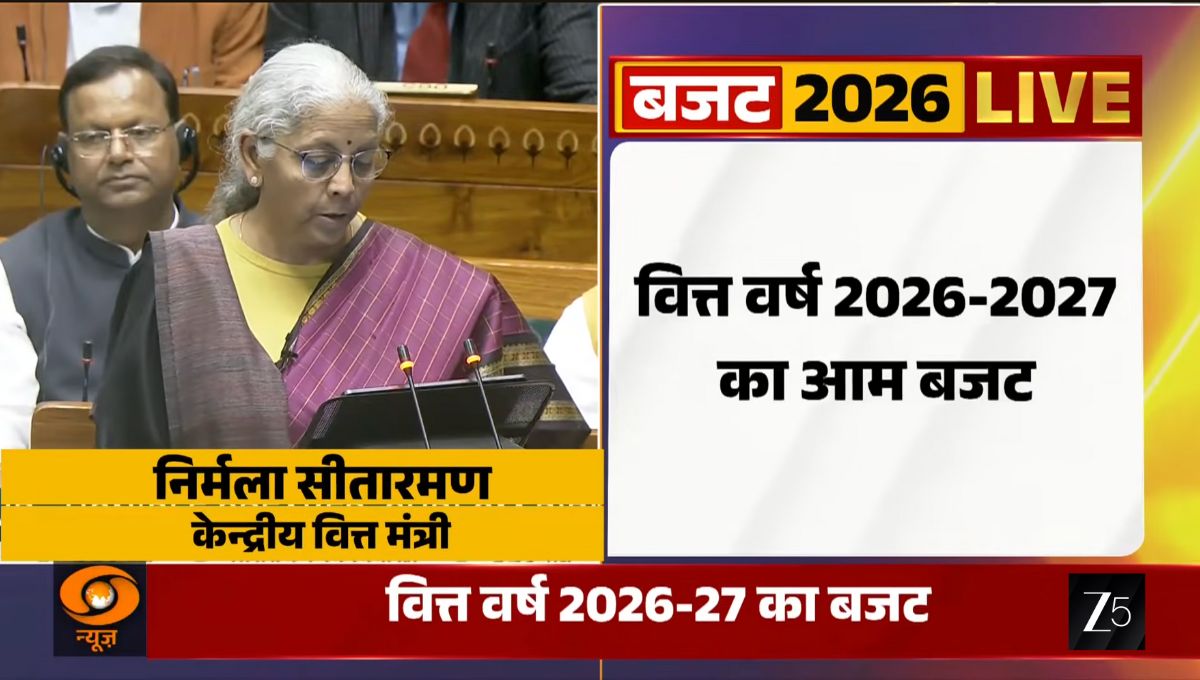
Let’s start with seedhi baat: this Budget isn’t trying to “shock and awe” you with flashy giveaways. It’s going for steady growth + controlled borrowing—more like laying a long highway than bursting a one-night firecracker. The big headline is spending on building India, while keeping the deficit on a tight leash.
Here are the macro numbers that frame everything:
Capital spend capex hits ₹12.21 lakh crore for FY 2026–27, rising from ₹11.21 lakh crore in FY 2025–26 RE.
Fiscal deficit sits at 4.3% of GDP for FY 2026–27, versus 4.4% in FY 2025–26 RE.
Debt-to-GDP stands at 55.6% for FY 2026–27 BE, versus 56.1% for FY 2025–26 RE.
Total spending equals ₹53.47 lakh crore for FY 2026–27 BE.
Total receipts excluding borrowings reach ₹38.63 lakh crore, revenue receipts ₹35.33 lakh crore plus non-debt capital receipts ₹3.30 lakh crore.
Gross tax revenue totals ₹44.04 lakh crore.
In plain English, the government says “We keep building big. But we’ll also keep the borrowing story under control.”
Now the real question: what does this do for you tomorrow morning?
What Changes For You Tomorrow Morning (The “Wallet Test”)
Budgets don’t usually change your life by issuing an MRP order. They change it through:
tax rules (income tax, TCS, STT)
import duties (which influence prices)
credit + capex (which influences jobs, growth, demand)
So your “tomorrow morning” impact is mostly about:
tax friction (how painful compliance feels),
a few price levers (select duty changes),
and job/credit momentum (which takes weeks/months to show up fully).
Income Tax: What Changes For Salaried People (And What Doesn’t)
If you were hoping for fresh personal tax cuts, the Budget’s message is basically: not this year. Many reports highlight no change in slabs/rates for FY 2026–27.
1) Slabs: Unchanged (Old Vs New Regime)
New regime (resident individuals) slabs (continuing):
₹0–₹4 lakh: Nil
₹4–₹8 lakh: 5%
₹8–₹12 lakh: 10%
₹12–₹16 lakh: 15%
₹16–₹20 lakh: 20%
₹20–₹24 lakh: 25%
Above ₹24 lakh: 30%
Old regime slabs (continuing):
₹0–₹2.5 lakh: Nil
₹2.5–₹5 lakh: 5%
₹5–₹10 lakh: 20%
Above ₹10 lakh: 30%
Also: the new regime continues as default, and you need to actively opt into the old regime if you want it.
2) The “Real” Middle-Class Story: A New Income Tax Law + Lower Compliance Stress
This is the sleeper headline. The Budget confirms the Income Tax Act, 2025 comes into effect from 1 April 2026, positioned as a simplification move.
There’s also a practical compliance tweak: taxpayers can file updated returns for the previous year up to March 31 (with a late fee), expanding the “fix-it window” for many ordinary filers who miss deadlines.
Pros (Salaried / Middle Class)
Certainty: no sudden slab shock; easier financial planning.
Simplification: if the new law genuinely reduces complexity, that’s less “CA panic season” stress.
More time to correct mistakes: updated return window is a genuine convenience.
Cons (Salaried / Middle Class)
No fresh tax relief despite EMIs and cost pressures—so many people will feel “meh.”
The benefit depends on execution: a “simpler law” on paper can still hide complexity in rules, notifications, and forms.
Inflation & Cost Of Living: What May Get Cheaper, What May Get Costlier
Let’s keep it simple: duties and transaction taxes don’t “command” prices, but they nudge them.
What May Cost Less (Or Hurt Less)
Personal use imports: tariff rate on taxed goods for personal use falls from 20% to 10%.
Health relief: the state drops basic customs duty on 17 drugs and medicines for cancer patients.
Overseas tour packages and LRS remittances: TCS falls to 2% for foreign study care remittances, plus tour packages under LRS plans.
What May Get Costlier (Especially For Active Traders)
F&O trading: Securities Transaction Tax increased—futures 0.02% → 0.05%, and options 0.1% → 0.15%.
A “Reality Check” (Because Prices Don’t Obey Speeches)
Even when duties fall, the consumer benefit depends on:
How much of the product is imported, how competitive the market is, and how quickly supply chains pass savings to you.
So yes—some relief can show up, but don’t expect a Bollywood-style “instant price drop montage.”
Jobs & MSMEs: The Budget’s Real Bet Is Credit + Capex
If you want the Budget’s philosophy in one line: build more + finance smarter.
1) Capex: The Job Domino Effect
Capex isn’t government hiring. It’s demand creation—roads, rail, corridors, buses, logistics. When public capex rises, it pulls a long chain: cement → steel → contractors → truckers → local services. The capex push is clearly elevated again this year.
2) MSMEs: More Finance, More Formal Growth
The Budget announces a ₹10,000 crore SME Growth Fund, plus a ₹2,000 crore top-up to the Self-Reliant India Fund—meant to expand growth-stage financing for smaller businesses.
3) States & Project Momentum
A reported highlight is the continued support via long-tenor interest-free loans to states for capex, increased to about ₹1.85 trillion from ₹1.5 trillion.
Pros (MSMEs / Job Seekers)
Capex creates job pipelines: construction, logistics, manufacturing supply chains.
More growth capital: funds and credit support can help serious MSMEs scale beyond “survival mode.”
Cons (MSMEs / Job Seekers)
Execution risk: schemes work only if lenders actually lend and businesses can absorb credit.
Small informal units may miss out unless paperwork/onboarding becomes truly simple.
Farmers & Rural Households: Less “Cash Handout,” More Productivity + Markets
This Budget leans toward productivity tools + rural enterprise support, rather than one giant direct payout.
A Notable New Rural Tech Move
The Budget proposes Bharat-VISTAAR, a multilingual AI tool integrating AgriStack portals and ICAR agricultural practices, meant to give farmers customized advisory support and reduce risk.
Rural Women-Led Enterprises
It also proposes SHE-Marts—community-owned rural retail outlets to help women move from credit-led livelihoods into enterprise ownership.
Pros (Farmers / Rural Households)
If advisory and market intelligence reaches farmers properly, it can reduce distress sales.
Enterprise support for women can boost household incomes beyond seasonal farm cycles.
Cons (Farmers / Rural Households)
Benefits aren’t always “felt tomorrow”; these are system-building moves.
Tech initiatives can become portal-heavy if last-mile support is weak.
Healthcare & Education: Quiet Moves, Potentially Big Household Impact
Household finances in India often break at two places: hospital bills and education costs. So even small policy shifts matter.
Healthcare Relief You Can Actually Explain To Your Family
Customs duty exemption on 17 drugs/medicines is one of the most directly pocketbook-friendly moves in the Budget narrative.
Capacity Expansion Signals
The Budget also proposes:
setting up NIMHANS-2 and upgrading mental health institutes, and
strengthening district hospitals by establishing Emergency and Trauma Care Centres and increasing capacity by 50%.
Pros (Households)
Duty relief can reduce costs over time in procurement-linked medicines.
Trauma and mental healthcare capacity can reduce catastrophic out-of-pocket shocks for vulnerable families.
Cons (Households)
Outcomes depend on staffing, procurement, and district-level execution—big “if.”
Duty relief doesn’t always fully pass through if pricing stays sticky.
Housing & Infrastructure: The Multiplier Play Continues
This Budget’s infrastructure story is consistent: keep capex high, keep deficit edging down, keep debt ratio declining.
There’s also a focus on regional development—like the plan for an integrated East Coast Industrial Corridor and the provision of 4,000 e-buses as part of the Purvodaya push.
How this helps the aam aadmi (realistically):
More projects → more local jobs → more demand in small towns and cities.
Better logistics can reduce delivered cost inflation over time.
But: don’t confuse this with “rent falls next month.” Housing affordability depends more on interest rates, local supply, and wages.
Green Energy / EVs / Energy Security: Incentives Through Inputs (Not Cash Giveaways)
The Budget nudges the ecosystem via customs-duty and manufacturing measures, including:
extending basic customs duty exemption for capital goods used in manufacturing Lithium-Ion Cells for battery energy storage systems,
exemptions on capital goods for critical mineral processing, and more.
Pros
Supports domestic supply chains and reduces long-run dependence on imports.
Makes EV and clean-energy manufacturing more competitive through input-cost strategy.
Cons
EV affordability still depends on financing, charging networks, and state-level execution—this is a 2–5 year play, not a 2–5 week one.
Markets & Investors: Stability For Long-Term Investors, A Speed Bump For Traders
Markets love predictability. Traders hate friction.
Fiscal consolidation (deficit 4.3%) is a macro-stability signal.
But active traders face higher costs due to the STT hike on derivatives.
Pros (Investors)
Capex + stability can support medium-term growth narratives.
Cons (Active Traders)
Frequent F&O strategies take a direct hit from higher STT.
Winners & Losers (A Practical Scoreboard)
Likely Winners
Patients needing certain essential medicines (duty exemption on 17 drugs).
Students/parents paying for overseas education/medical remittances (TCS down to 2%).
People importing for personal use (tariff rate 20% → 10% on dutiable personal imports).
Job-linked sectors riding capex: construction, logistics, manufacturing suppliers.
Growth-focused MSMEs if the SME Growth Fund and credit channels execute well.
Likely Losers
F&O traders (higher STT).
Those expecting fresh personal tax cuts (no slab change headline).
Industries facing exemption pruning/rationalisation (where duty structures are being simplified, some may lose legacy advantages).
Hype Vs Reality: What To Believe, What To Watch Closely
Hype: “This Will Reduce Prices Immediately”
Reality: Duty cuts help, but pass-through depends on competition and supply chains. Medicines and personal imports are more directly linked, but not every category will show instant relief.
Hype: “No Tax Change Means Nothing Changed”
Reality: A new Income Tax law and compliance changes can reduce friction. Less paperwork isn’t glamorous, but it’s real quality-of-life improvement for ordinary taxpayers.
Hype: “Capex Always Creates Jobs Overnight”
Reality: Capex creates pipelines, not miracles. Tendering, execution, and private investment follow-through decide job outcomes. Still, the higher capex target is a strong intent signal.
So… Has This Budget Helped The Aam Aadmi?
If we judge it like a household budget, it’s not the “salary hike” moment. It’s the “we’re fixing the plumbing” moment.
Near-term relief: focused duty cuts for medicines and personal imports, plus lower TCS on foreign spends.
Mid-term impact: jobs and income rely on capex turning into ground work and MSME finance moving.
Middle-class mood: stable but not celebratory—no new tax candy, but simplification could reduce stress.
In mild Hinglish: yeh Budget “instant cashback” nahi, “long-term value” type hai.
What You Should Do Now (Quick Checklist)
If you’re salaried:
Decide early whether you’re staying in the new default regime or opting old (only if deductions truly justify it).
Track notifications/forms tied to the Income Tax Act, 2025 from 1 April 2026—small rule changes can matter.
If you run an MSME:
Watch for SME Growth Fund / credit windows via banks and industry bodies—these are execution-driven benefits.
If you’re paying for overseas education/medical:
Recalculate cashflow: TCS at 2% changes the upfront outgo.
If you trade derivatives:
Rework your cost assumptions—STT hikes matter if you trade frequently.
If healthcare costs hit your family:
Ask your doctor/pharmacy if any of the duty-exempted medicines apply; benefits may show gradually through procurement cycles.
Bio of Author: Gayatri Tiwari is an experienced digital strategist and entertainment writer, bringing 20+ years of content expertise to one of India’s largest OTT platforms. She blends industry insight with a passion for cinema to deliver engaging, trustworthy perspectives on movies, TV shows and web series.